
A cup of coffee led me to Basha.
A guest blog post by Cathy Stevulak, Director, Producer, THREADS do
My husband and I lived in Bangladesh and traveled throughout the country. We were particularly interested in the work of women creating handcraft in cities and villages. Women worked quietly in their homes and community spaces, without much recognition and in addition to their domestic duties. Their handcraft was exquisite.
It was at a craft fair in Dhaka that we discovered kantha. Kantha is an indigenous quilt made in Bangladesh and West Bengal, traditionally from old clothing such as saris and lungis. Kanthas were used as bedcovers, wrappers for books, and other items of daily use. More elaborate kantha were embroidered with scenes telling stories from the hearts and minds of the women who made them, often including symbolic motifs and patterned borders and used on special occasions or for gifts to be passed down through generations.
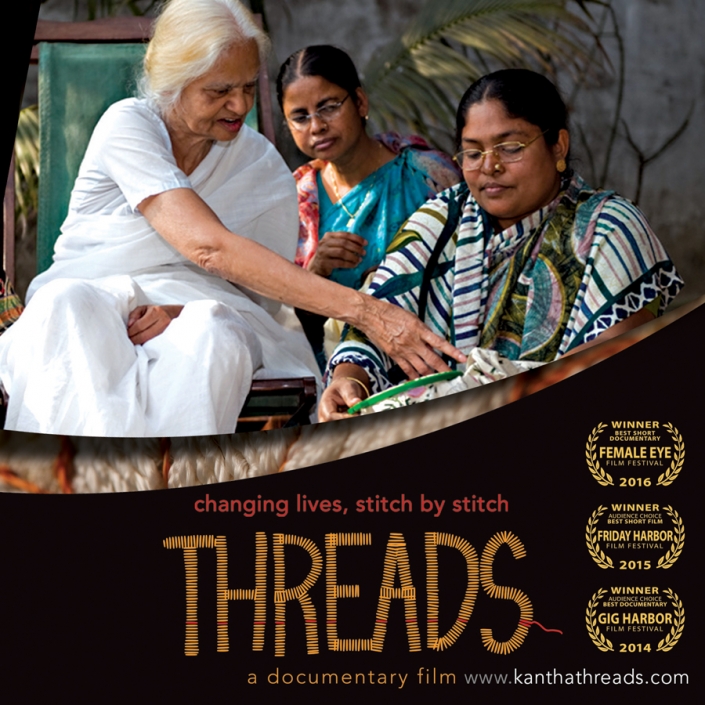
By chance, my husband and I met Surayia Rahman—a gifted painter who made the extraordinary choice to devote her talent to kantha embroidery, training hundreds of women to tell stories through her intricate designs. Surayia refined the domestic art of kantha, pioneering “nakshi kantha tapestries” for public display. Surayia and the women she inspired moved us deeply and led to the creation of the documentary film THREADS.
THREADS weaves together Surayia’s story and the voices of the artisans she led, showing their journey as they worked together. Despite personal and professional adversity, these women never gave up, empowering themselves and building a close community to create exquisite hand-stitched art. THREADS celebrates the enduring, transformative impact women artisans have, stitch by stitch, on families, communities, and generations to come.
Here is the link to watch THREADS movie and trailer.
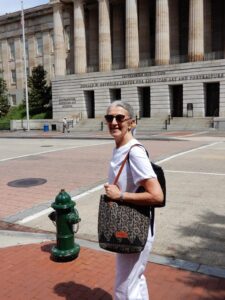
While I was drinking my coffee at North End Coffee Roasters in Dhaka, I noticed in the cafe a beautiful display of hand-stitched blankets by Basha artisans. I recognized the kantha stitching, and wanted to know more about the artisans who made them. I brought home some Basha handbags, made with a typical kantha running stitch, and carry mine with me often.
People who see the handbags comment on the fine stitching, the quality construction, the practicality of design and the aesthetic elements such as hand block printing. I was very pleased to see Basha selected for the International Folk Art Market in Santa Fe, and then to have their kantha artwork displayed at Amy Kaslow Gallery in Washington, DC.
The exponential potential of choosing “handmade”
Basha works to create a society where artisans are valued. We can support that dream by understanding the time it takes to create handcrafted items and by paying fair prices to adequately provide livelihoods for the artisans. Thus, each of us can make a difference and open possibilities and futures for artisans and families, creating a ripple effect of hope for generations.
What the Basha artisans said about THREADS movie
Basha artisans watched a special version of THREADS, dubbed in Bengali. I was delighted to read their thoughtful reactions and to see them try their hand at creating their own designs. These are some of their comments:
Kobita: “Needle and thread are our friends; needle and thread can change our destiny.”
Rima: “Inspired by Surayia Rahman, I want to educate and raise my daughters with the same dedication and strength.”
Sahnaj: “Watching the rice husking pedal (dheki) in the documentary brought back warm memories of my childhood.”
Dhaka artisans: “Our nakshi kantha is an art, yet we receive little recognition. While we cannot travel abroad or visit special places, our handiwork – our kantha – reached all over the world.”
Ratna: “Even if no one is there to support us during difficult times, we should not lose hope. I believe that better days will come one day. “
Urmi: “We will move forward together, hand in hand.”
Overall, the documentary was more than just a compelling story – it serves as a powerful reminder of how dedication and grit can transform hardships into meaningful success.
Thank you! ধন্যবাদ
Cathy Stevulak
Director, Producer
Purchase part of the story! We have Surayia Rahman’s embroidered art available! While supplies last