
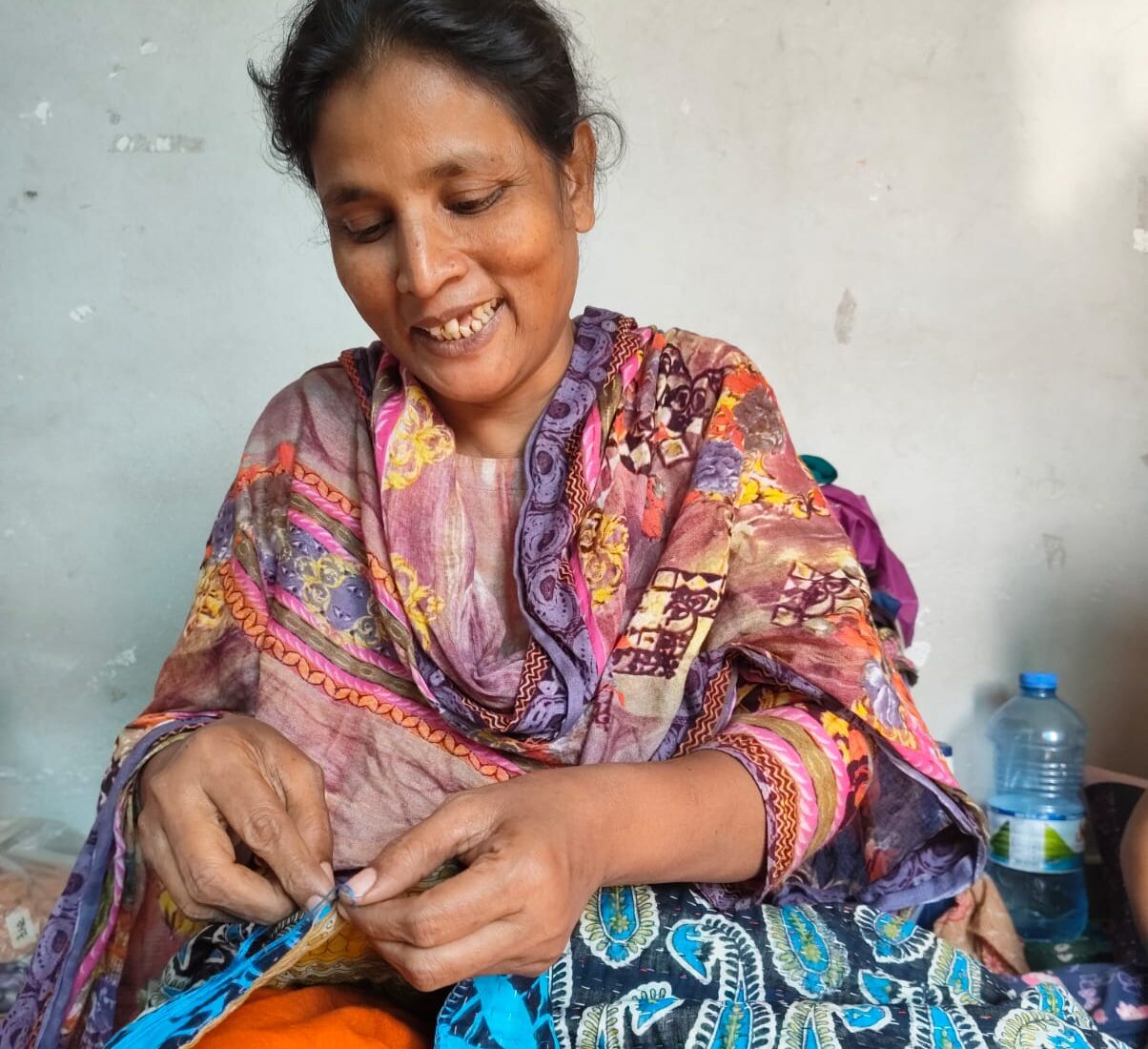
Helena, Basha’s Director of Operations, shares this story of helping a young woman in extreme mental distress:
When I first saw Amina (name changed), she was sitting by a busy intersection near our office, visibly distressed, unclothed, and talking to herself. I immediately contacted Robin in the U.S. and, with her support, decided we had to help. After confirming no one in the area knew her or her family, we returned with three artisans and one staff member.
I carried a beautifully hand-stitched, naturally dyed bathrobe made by Basha artisans to offer her. At first, Amina refused all help. Every offer of food or clothing was rejected. She walked away and continued talking to herself.
After persistent care and patience from our artisans and staff, Amina was brought into the Friends of Basha office, a private and safe space. Even there, she was frightened, screaming and pleading with us not to touch her. For several hours, she refused food and water. Slowly, through gentle reassurance, she accepted a glass of water and then requested chicken biryani.
Through fragmented words, Amina shared pieces of her past: she had experienced difficult family relationships and past trauma. Her words were scattered; she would sometimes speak to herself or erupt in anger.
After careful consideration, we decided to take Amina to the government mental health institute. The journey was challenging, but our staff’s determination secured her a bed in the emergency ward. One of our artisans, Rani, volunteered to stay with Amina around the clock. Rani herself had faced mental health challenges, but caring for Amina strengthened her patience, a growth she proudly shared with me when she returned to work over a month later.
From late July to early September, Amina stayed in the hospital, navigating the difficulties of confined spaces, routines, and medical care. She struggled to adjust and often asked why her freedom had been taken. Yet gradually she began to show signs of trust and stability. Despite her trauma, by late August she began sleeping through the night, a small but meaningful step toward recovery.
When the hospital unexpectedly required her discharge, finding a suitable place for Amina seemed impossible. Most organizations we contacted were not equipped to care for women like her. One staff member at the hospital even told me, “There is no hope for women like her.”
Finally, through a friend, we connected with an organization that provides two-year residential care for women with mental health challenges. The program offers stability, medical care, daily meals, and vocational training. Within days, Amina was admitted, and she has been there since early September. Rani continues to visit, forming a deep bond with Amina and helping her adjust to her new environment.
Through ongoing care and supportive relationships, we hope Amina will gradually find stability, trust, and a sense of safety.
As an enterprise creating handmade products which we send all over the world, stopping our work to help women like Amina would be seen by many as a distraction. It was challenging for our team and artisans to throw themselves into her care. But at Basha, pausing to care for those in need is an integral part of our culture. It’s so much beyond even employment. It’s women becoming a healing community together.
Consider being part of this community by giving to Friends of Basha, helping to provide for all that Amina received: safety, dignity, and hope when she had nowhere else to turn. A key component of this support is ensuring women in Basha’s programs receive appropriate mental health care, care that sees them not as hopeless, but as beloved.